

How aggressively should you deploy risk right now?
Trend Posture translates trend maturity, leadership, and timing into a clear market posture — so you can decide when to press, when to scale back, and when to stay defensive.
Environment first. Risk posture second. Execution third.
Trend Maturity
Survival-based posture grounded in the market segment swing traders actually trade.
Leadership + Timing
Know where capital should be focused, and whether conditions are supportive.
Phase 1: collect feedback, calibrate posture outputs, and share early previews.
The Trend Posture Framework
Most traders focus on entries and exits. Trend Posture starts with the environment first. The framework is designed to answer one question:
How aggressively should you deploy risk right now?
From environment to action
Trend maturity sets posture. Leadership and timing provide context. Risk deployment is the practical output.
Posture sets the level of risk. Timing adjusts it.
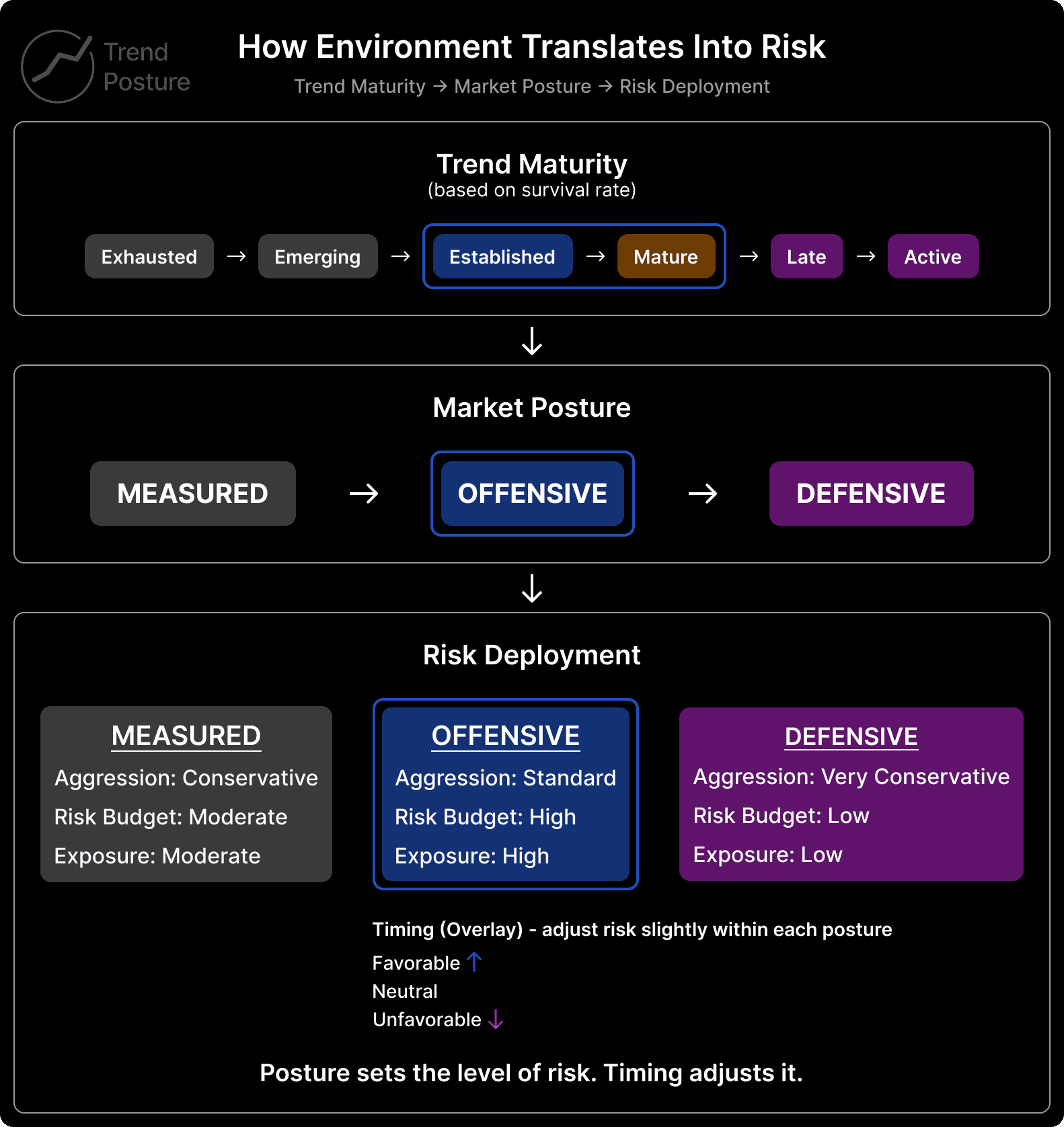
Measured
Probe carefully. Moderate exposure. Conservative aggression.
Offensive
Press when continuation odds are strongest. Higher risk budget. Higher exposure.
Defensive
Protect capital when trends weaken or conditions deteriorate.
What Trend Posture is
A posture-first dashboard for intermediate-term swing traders. It translates trend maturity, leadership, breadth, and timing into a consistent market posture.
Trend maturity
To define baseline posture from improving, established, or deteriorating conditions.
Leadership
To show where strength is concentrated.
Timing
To identify when conditions support expansion.
Risk deployment
To guide how aggressively capital should be put to work.
Trend Maturity Engine
A watchlist-derived equal-weight index used for weekly trend structure, trend maturity modeling, and daily price action context.
Breadth + Participation Layer
Computed directly from watchlist members (adv/dec, % above MAs, highs/lows, etc.).
Leadership Layer
Tracks where relative strength is concentrated so posture and timing stay grounded in the segment of the market actually leading.
Leadership tells you where to focus
Strong markets are not just about index direction. They are about whether leadership is productive, broadening, narrowing, or exhausted.
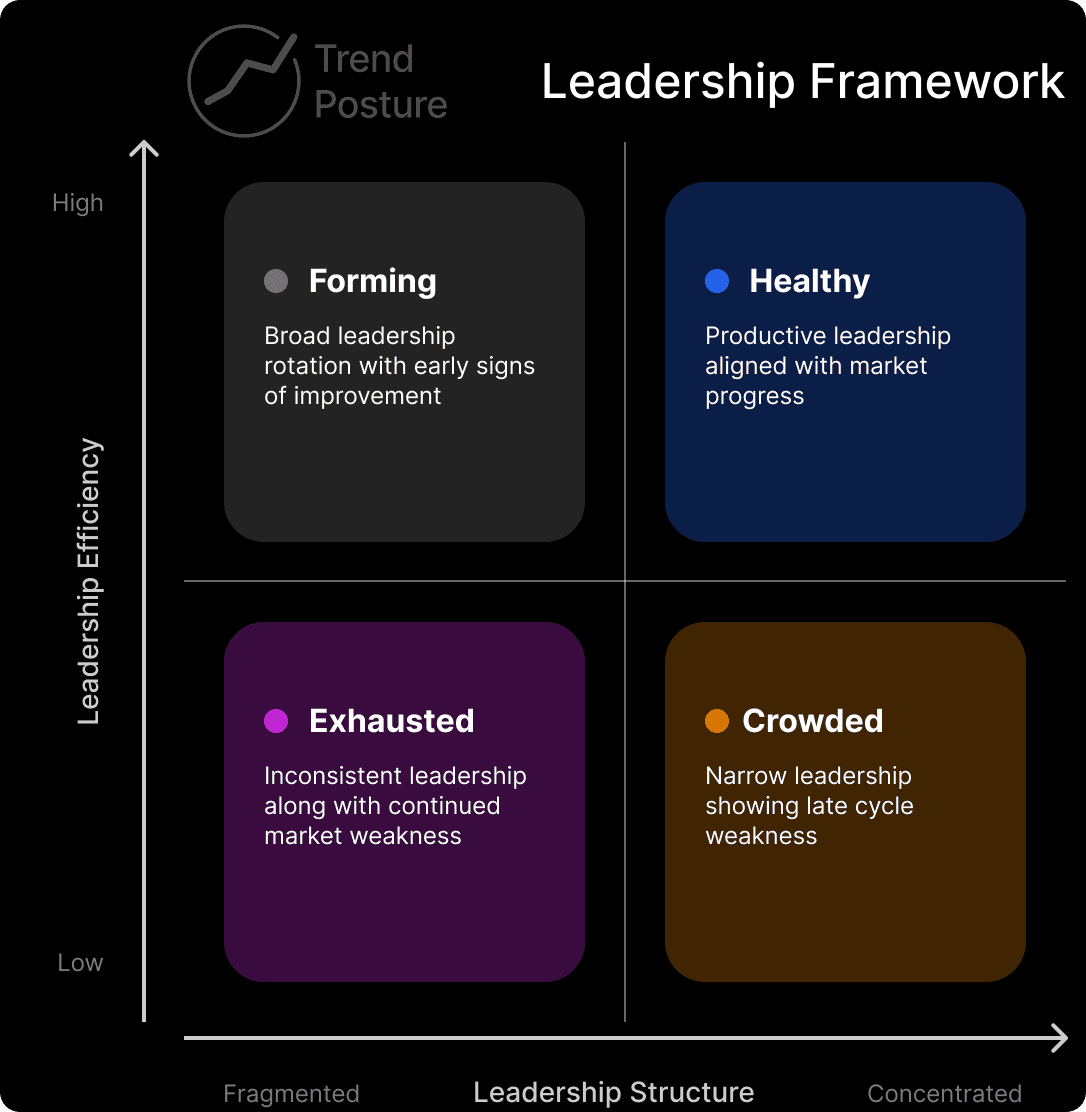
Leadership structure shows whether participation is expanding through the trend or narrowing into fewer names.
Leadership efficiency helps distinguish productive strength from crowded or weakening conditions.
Leadership doesn't set posture directly. It tells you how much conviction to place in the trend and where capital should be focused.
How the framework shows up in the dashboard
A single view of market posture, trend maturity, leadership, and timing — designed to guide how aggressively risk should be deployed.
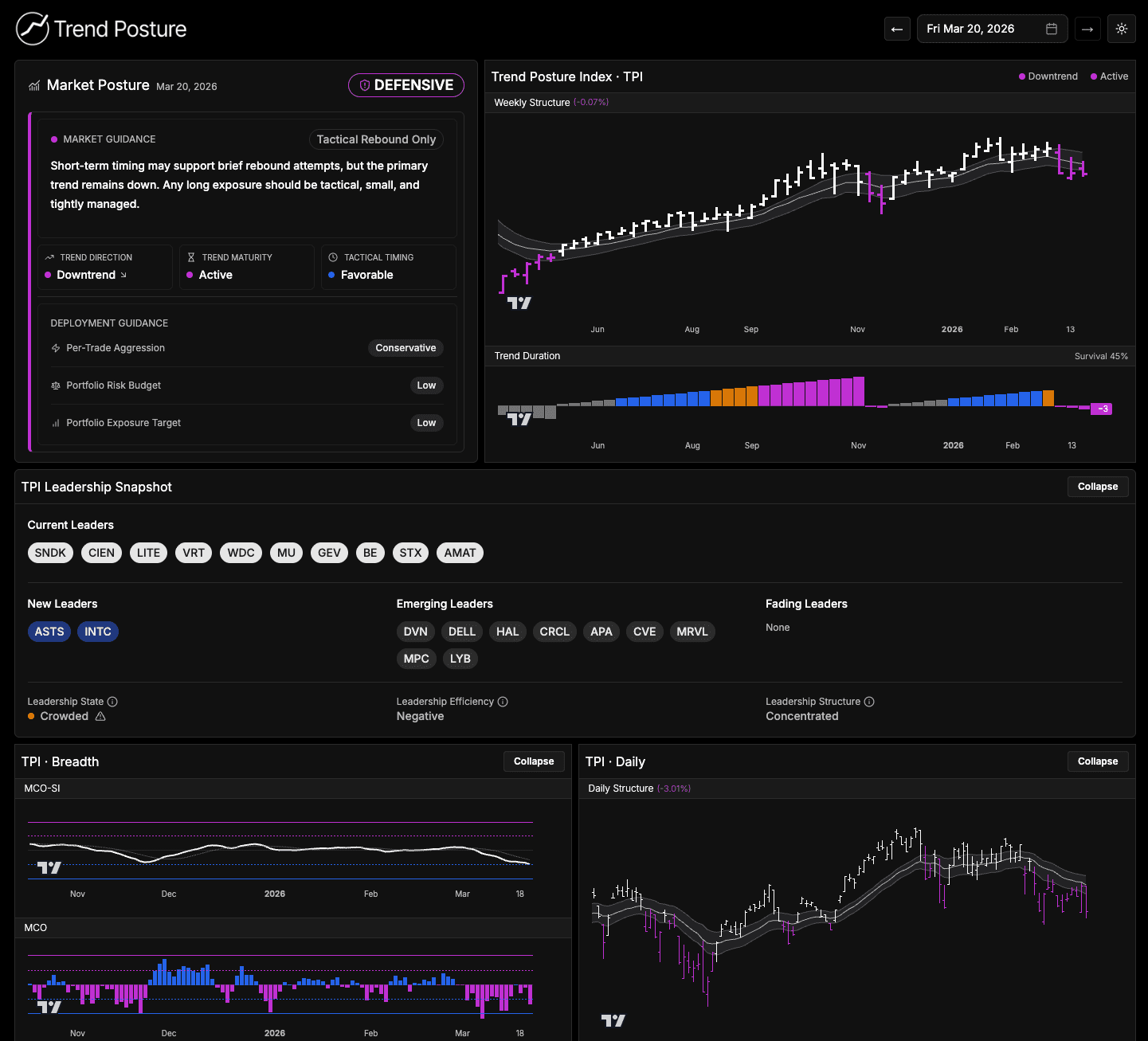
A complete operating view
See market posture, trend maturity, leadership, and timing in one place — so environment, conviction, and risk deployment stay connected.
Breaking down the dashboard
Each panel reflects a key layer of the Trend Posture framework.
Market Posture
Baseline posture, timing context, and risk guidance at a glance.
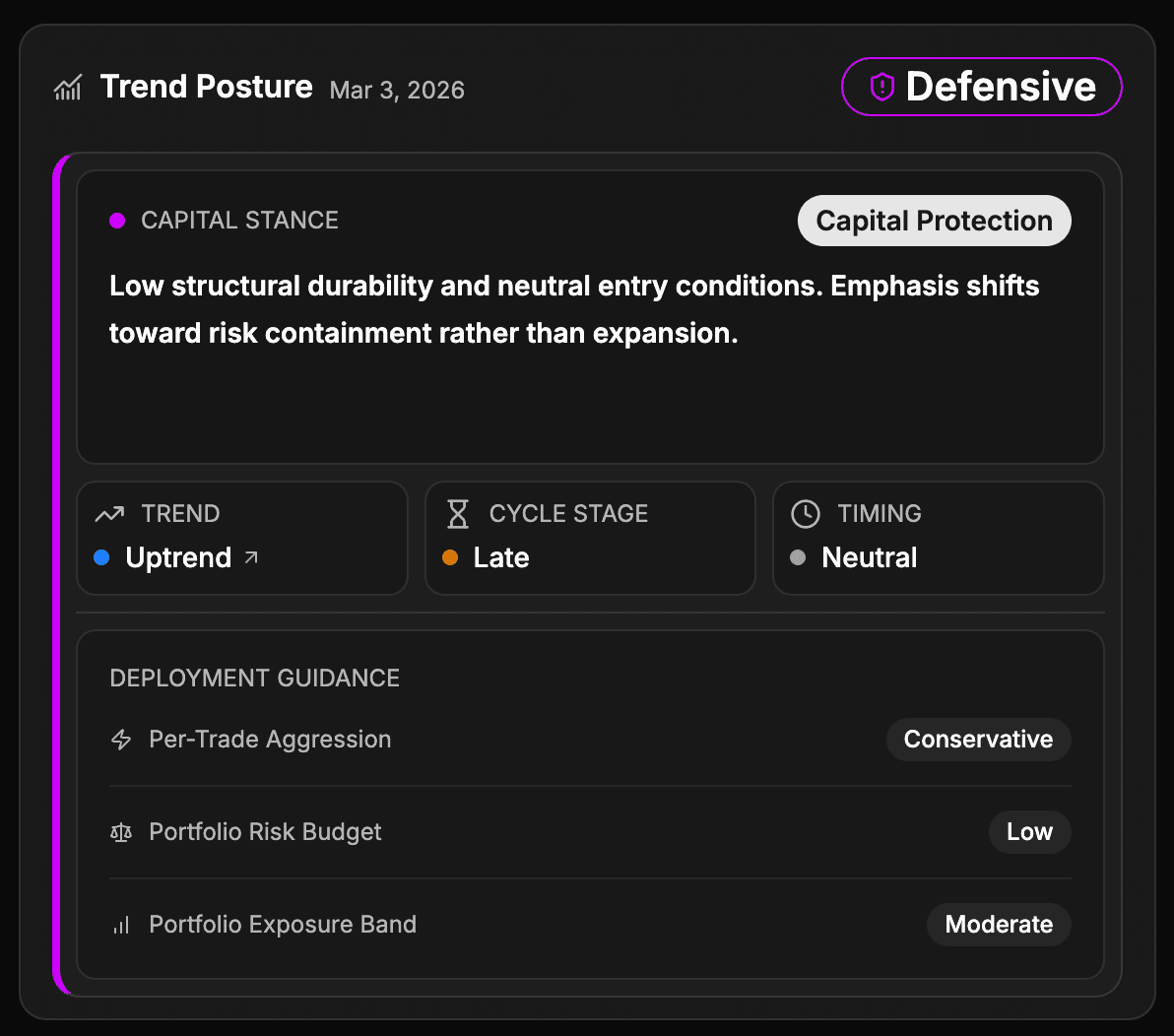
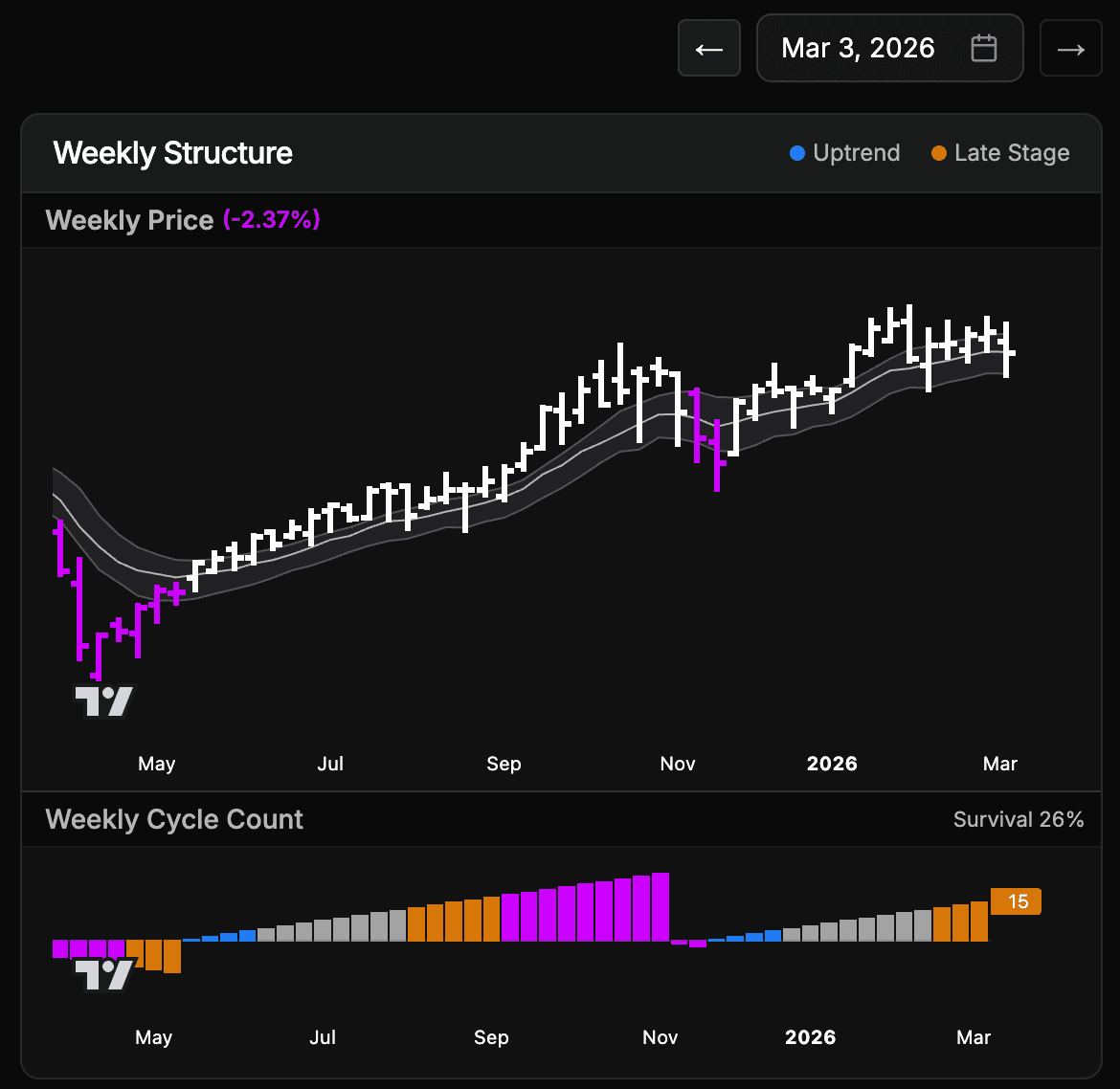
Trend Maturity
Weekly structure and trend progression used to determine posture.
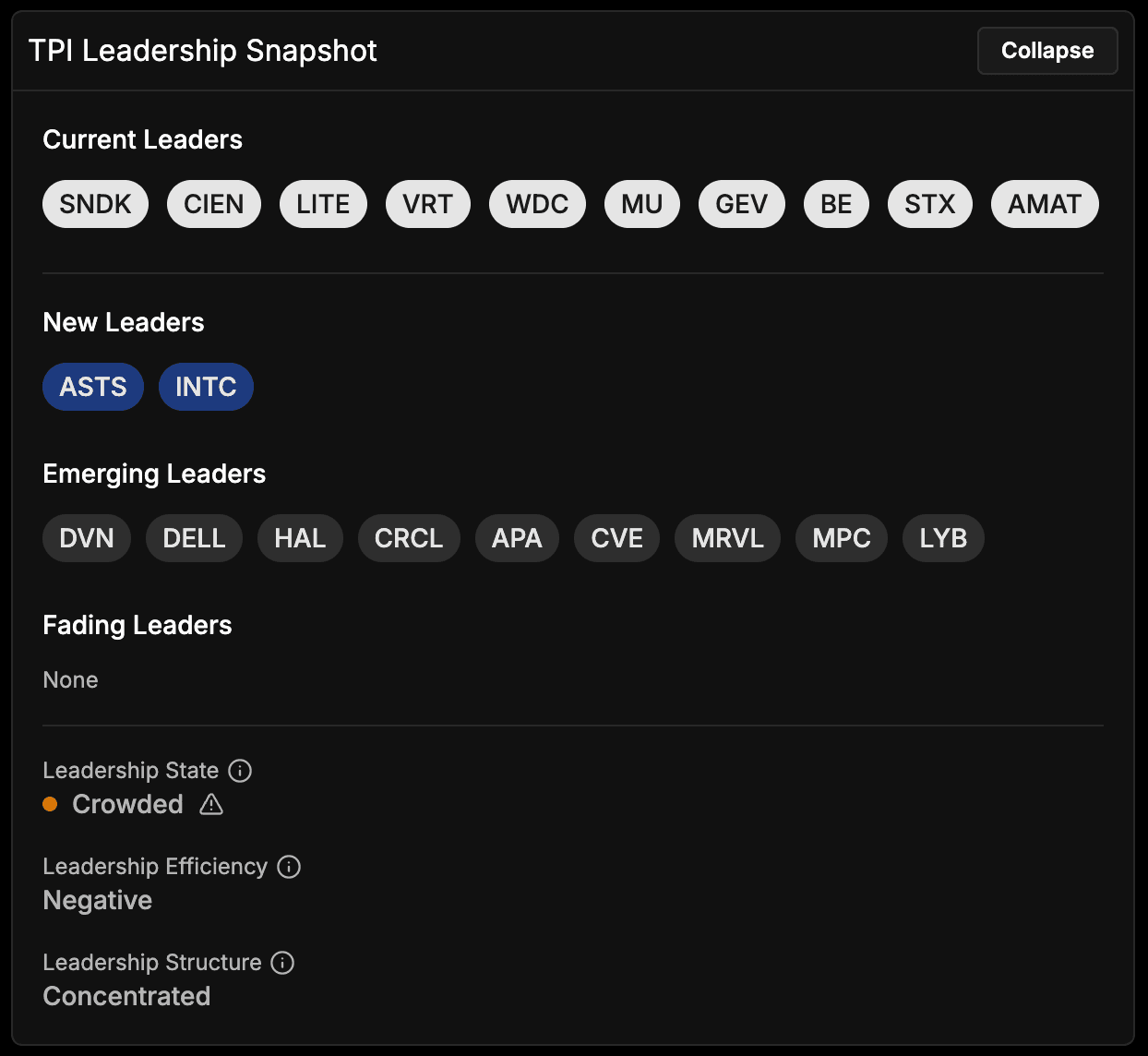
Leadership
Leadership structure, efficiency, and leader lists that help define conviction and focus.
Breadth + Timing
Participation and short-term conditions across the liquid leader universe.

Why it's different
Built around what swing traders actually trade — not broad index averages that often hide what matters.
- Breadth computed from an adaptive liquid leader universe, not static index constituents.
- Trend maturity modeled from a watchlist-derived index, not headline benchmarks.
- Leadership tracked through structure and efficiency, not just relative performance.
- Risk outputs framed in practical terms: aggression, budget, and exposure.
- Historical replay for research, review, and post-trade learning.
Outputs emphasize posture, risk, and exposure based on survival odds and timing context — not trade calls. Built for traders who already have a process and need context that respects their universe and sizing rules.
How it fits into your process
Trend maturity sets baseline posture. Leadership and timing provide context. Risk deployment is the practical output.
Leader lists highlight current, new, emerging, and fading names.
Per Trade Aggression
Adjust position sizing and per-trade risk based on baseline posture, then refine it with timing.
Portfolio Risk Budget
Increase or restrict new risk as posture sets the baseline and leadership and timing confirm or weaken conviction.
Stop Flexibility
Decide how much room positions should have based on the current posture and how supportive short-term conditions are.
Overall Exposure
Set total capital deployment from the baseline posture, then lean in or hold back as context improves or deteriorates.
Uptrend + Defensive posture + Unfavorable timing
Reduce aggression: lower per-trade risk, tighten the portfolio risk budget, and reduce overall exposure.
Uptrend + Offensive posture + Favorable timing
Allow offense: normal to aggressive risk per trade, full risk budget, high exposure levels.
Buckets, thresholds, and posture states are grounded in historical distributions and backtesting for intermediate-term trend-following swing trading.
The goal is consistent decision support — not prediction.
Who it's for / not for
Designed for traders who manage risk systematically and want clear market posture.
Traders who run their own rules-based or structured process and want regime clarity.
Trend following traders holding positions from weeks to months in liquid equities.
Traders who size based on portfolio heat, exposure caps, and survival probabilities.
Traders documenting posture for daily or weekly reviews.
Anyone looking for trade calls, alerts, or stock picks.
High-frequency strategies that require tick-level data.
Fully discretionary approaches that don’t incorporate structured risk management.
Beginners learning the basics of trading.
People wanting performance promises or shortcuts.
Pricing & beta
The first cohort will be small and feedback-driven. Waitlist members will be first to hear when beta access opens and founder pricing becomes available.
Limited beta
Priority for traders who value structured market context and are willing to share feedback during validation.
FAQ
Straight answers. No promises or predictions.
Join the waitlist
Priority accessGet early access to a dashboard built to help swing traders interpret environment, set posture, and deploy risk more intentionally.
Disclaimer: Informational only. Not investment advice. No offers to buy or sell any security. Use your own judgment and risk controls.